
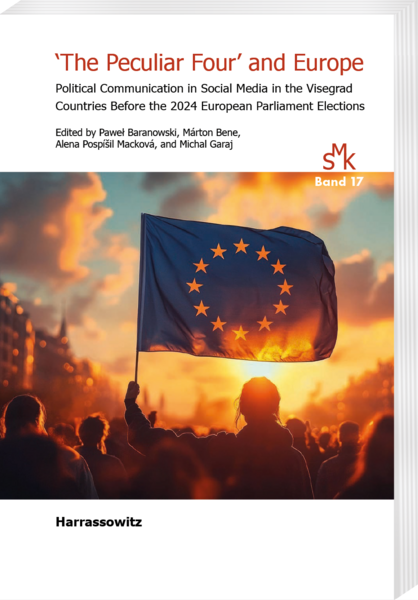
We are pleased to announce the publication of a new edited volume, The Peculiar Four and Europe, edited by Paweł Baranowski, Márton Bene, Alena Pospíšil Macková, and Michal Garaj. The book offers a comparative perspective on how political actors across the Visegrád countries used social media in the run-up to the 2024 European Parliament (EP) elections. The volume is available in open access.
The book examines campaign communication in a context marked by overlapping crises, increasing political polarization, and the growing centrality of platforms—most notably Facebook—in shaping electoral competition. By focusing on the Visegrád region, the volume highlights both shared structural conditions and important national specificities in how Europe, domestic politics, and political leadership are communicated online ahead of EP elections that have traditionally been considered low-salience contests.
Members of the PRiSMa research group contributed to multiple chapters of the volume:
Márton Bene co-authored the chapter “Political Communication in the V4: Contexts, Challenges and Research Traditions” together with Paweł Baranowski, providing a conceptual and contextual overview of political communication research in the region.
Krisztina Burai, Virág Bagi, and Vanessza Juhász authored “Disruption and Continuity: A Comparative Analysis of Hungarian Political Leaders’ EP 2024 Campaigns on Facebook”. The chapter explores how leading Hungarian political actors approached the 2024 EP campaign on Facebook, asking to what extent campaign communication reflected established patterns of digital campaigning and where signs of change or adaptation emerged. Details about this chapter can be found in our latest blog post.
Krisztina Burai and Paweł Baranowski contributed the chapter “European or National? Issue Strategies in the 2024 EP Campaign in the V4”, which examines how political actors across the region balanced European and domestic issues in their campaign communication.
Finally, Virág Bagi authored “The Peculiar Four: A Comparative Analysis of Illiberal Communication Strategies on Social Media and Their Influence on User Engagement in the Visegrád Countries”, offering a cross-national perspective on illiberal communication styles and their mobilizing potential online.