
Péter Ádám Újvári (2026). „Hazaárulók, tolvajok, szívtelenek”: Morális keretezés a magyar politikai kommunikációban [“Traitors, thieves, heartless”: Moral framing in Hungarian political communication]. Politikatudományi Szemle, 35(1), 33-58. https://doi.org/10.30718/POLTUD.HU.2026.1.33
This article examines how Hungarian political actors strategically use moral emotions in their social media communication during election campaigns. While political debates are often framed in terms of ideology or policy, the study starts from a simpler premise: people relate to politics not only through ideas, but through feelings—especially strong feelings about what is right and wrong.
In political psychology, these are often referred to as moral emotions. Actors can activate them by framing issues in ways that resonate with different moral foundations—care, fairness, liberty, loyalty, authority, and sanctity. The article explores how such moral framing appears in real-world political communication.
The analysis focuses on two key campaign periods: the month preceding the 2022 Hungarian parliamentary elections and the month before the 2024 European Parliament elections. Using quantitative content analysis, the study systematically examines how parties and leading politicians framed their messages on social media, and which types of moral appeals they relied on.
What kinds of moral frames do political actors use?
One of the central questions of the article is how different political actors mobilize moral arguments in their communication. The study looks at morality and moralization as a strategic tool which can be manifested through different ethical lenses across different political actors. The study refers to a “moral frame” not as a standpoint or message that the author deems correct, but as a communicative act that claims something (an act, a thought, a policy approach, etc.) to be right or wrong.
The findings show interesting patterns across three political blocs, the governing parties, the “traditional opposition” (members of the 2022 coalition and the 2024 left-liberal EP-list), and Péter Magyar.
Figure 1. Proportions of moral foundations relative to all moralizing posts in a given bloc, and the phi coefficient (φ) of the correlation between bloc and foundation variables. (* p< 0,05; ** p<0,01; *** p< 0,001)
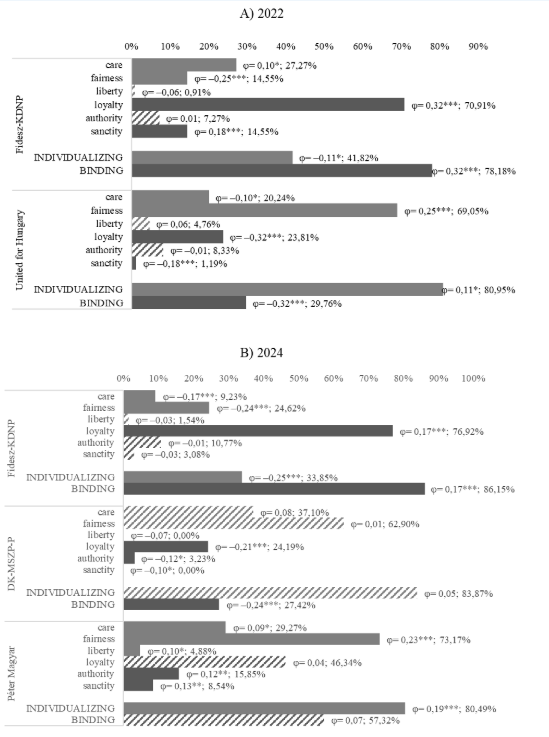
Government actors frequently relied on moral frames that emphasize loyalty, betrayal, and the protection of the community. Their communication often framed political opponents as threats to the nation, using emotionally charged language that invokes ideas of disloyalty or even “betrayal.”
The “traditional opposition’s” moral frames were generally incongruous, only coherent insofar as they tended to avoid the moral foundations dominant in Fidesz’s communication.
The 2024 European Parliament campaign introduced a new dynamic with the entry of Péter Magyar into the Hungarian political landscape. Rather than relying on a single dominant type of moral framing, Magyar’s messaging combined elements from both sides. This kind of moral pluralism is manifested in two ways: a) his communication does not statistically avoid any moral foundation, b) compared to the governing parties and the “traditional opposition,” he applies multiple moral frames simultaneously within individual posts.
Table 1. Proportion of posts containing multiple moral foundations, by bloc.
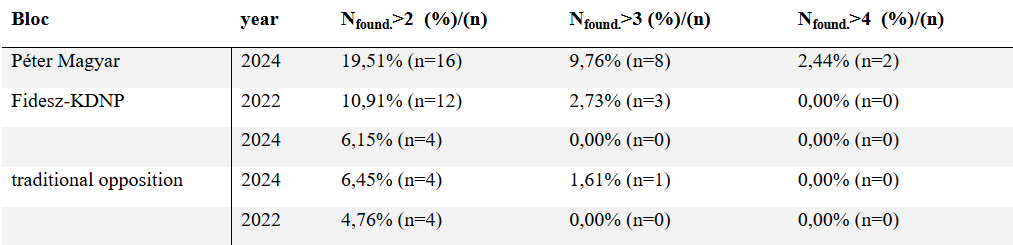
This synthesis allowed him to connect with multiple audiences at once, drawing on a broader repertoire of moral emotions. In this sense, his campaign can be seen as a synthesis of previously competing communicative logics. Why moral emotions matter in political communication The findings highlight a broader point: political communication is not just about conveying information or arguments. It is also about shaping how people feel about political actors and issues. Moral framing plays a crucial role in this process because it taps into deeply rooted intuitions about right and wrong. These intuitions can structure how people interpret political messages, evaluate actors, and ultimately make political decisions. Importantly, the article does not argue that one side is “more moral” than the other. Instead, it shows that all major political actors rely on moralization as a core communication strategy—albeit in different ways.
Conclusion
Overall, the study demonstrates that moral emotions are not just a byproduct of political communication, but one of its central building blocks. Hungarian election campaigns—both in 2022 and 2024—were deeply shaped by the strategic use of moral frames, which helped actors mobilize supporters, attack opponents, and define the stakes of political competition. At the same time, the emergence of new actors and strategies suggests that these patterns are not fixed. As the political landscape changes, so too does the way moral language is used—opening up new possibilities for how politics is communicated and experienced.