
Burai, K., Bagi, V., & Juhász, V. (2026). Disruption and continuity: A comparative analysis of Hungarian political leaders’ EP 2024 campaigns on Facebook. In P. Baranowski, M. Bene, A. Pospíšil Macková, & M. Garaj (Eds.), The Peculiar Four and Europe: Political Communication in Social Media in the Visegrad Countries before the 2024 European Parliament Elections. Wiesbaden: Harrassowitz Verlag.
The chapter, examines how leading Hungarian political actors used Facebook during the 2024 European Parliament (EP) election campaign. The chapter explores the coexistence of continuity and disruption in a campaign environment strongly shaped by domestic political dynamics.
First, it asks to what extent Hungarian party leaders differed in their strategic approaches during the EP campaign (RQ1). The 2024 elections were held simultaneously with local elections and marked the first electoral appearance of a major political newcomer, Péter Magyar. In this context, the chapter examines which political level leaders emphasized in their Facebook communication: did they focus primarily on EU-level politics, or did they instead highlight national and local issues (RQ1a)? In addition, given that Hungarian political communication has often been described as both populist and negative, the chapter explores whether established patterns of negative campaigning persisted or changed under these new conditions (RQ1b).
Second, the chapter examines the extent to which candidates employed populist campaign strategies during the EP campaign (RQ2). While negative campaigning and populist communication are often intertwined, they are treated as analytically distinct. The analysis captures populist strategies through multiple indicators, including references to “the people,” criticism of elites, fear-based rhetoric, the portrayal of threatening political “others,” crisis narratives, and populist elements in visual and nonverbal communication. This approach allows for a systematic comparison of the scope and character of populist communication across the leading Hungarian candidates.
The analysis focuses on the three leading Hungarian candidates whose party lists gained seats in the European Parliament: Tamás Deutsch (Fidesz–KDNP), Péter Magyar (TISZA), and Klára Dobrev (DK–MSZP–P–Greens). All Facebook posts published by these candidates during the month preceding the 2024 European Parliament elections were coded (N = 509).
Political level of posts
Despite the simultaneous holding of local and European Parliament elections in 2024, campaign communication on Facebook was overwhelmingly national in focus. More than half of all posts (54%) addressed Hungarian national politics, while local issues appeared in 14% of the content. In contrast, EU-level topics were almost entirely absent, accounting for just 1% of posts, and references to EU values were rare.
These findings suggest that Hungarian EP candidates primarily treated the campaign as a domestic political contest. Facebook was used mainly to engage in national political conflict, mobilize emotions, and signal closeness to voters, rather than to communicate about European issues or policies.
Negative Campaigning
Negative campaigning was common but unevenly distributed across candidates. Deutsch used negative messaging the least (8% of his posts), primarily targeting national political actors. Dobrev relied on negative campaigning the most (43%), mainly criticizing the government but also other opposition actors, especially Magyar. Magyar’s campaign fell in between, with 26% of his posts containing negative elements.
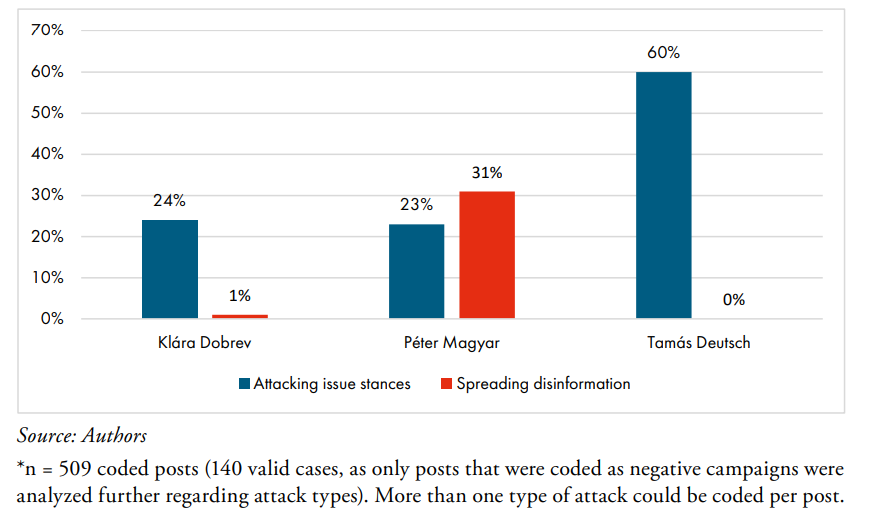
Two main types of negative campaigning emerged (see Figure). Attacks on issue stancfes—especially related to the war in Ukraine—were most typical of Deutsch’s communication. In contrast, accusations of spreading disinformation appeared almost exclusively in Magyar’s campaign, reflecting his response to personal and political attacks. Personal attacks on credibility and integrity were present across all candidates, with no significant differences between them.
Populist strategies
All three candidates employed populist elements, but with clear differences. Populist communication was more pronounced among the opposition candidates, Dobrev and Magyar, particularly through elite criticism targeting the Hungarian government. However, Magyar relied less on references to “dangerous political others” than Dobrev. Deutsch, by contrast, used more fear-based rhetoric and crisis framing, especially in relation to the war in Ukraine.
Visual and nonverbal communication played a central role in populist strategies. Magyar’s campaign relied heavily on images from campaign events and direct voter contact, while Dobrev’s visuals contained the most negative elements. Symbolic communication also differed: patriotic symbols appeared most frequently in Magyar’s posts, while European symbols were most visible in Dobrev’s communication. These patterns underline the continued importance of nationalist and emotional appeals even in a European Parliament campaign.
Conclusion
Overall, our findings show that despite the supranational nature of the 2024 European Parliament elections, campaign communication in Hungary remained strongly focused on national actors and issues, a pattern reinforced by the simultaneous local elections and a turbulent political context. Negative campaigning varied markedly across candidates: Dobrev relied on it most extensively, Magyar used it more selectively against both the government and the traditional opposition, while Deutsch largely avoided direct attacks, likely reflecting the governing coalition’s broader media environment. Populist strategies also differed, with fear-based rhetoric and crisis framing most prominent in the governing party’s campaign, while opposition actors emphasized elite criticism and, notably in Magyar’s case, the frequent use of nationalist symbolism.