
Paulke, H., Kruschinski, S., Bene, M., Haßler, J., Jackson, D., Lilleker, D., Magin, M. & Russmann, U. (2026). Does Negativity Pay Off? The Impact of Political Party Attributes on the Use and Performance of Negative Campaigning in Digital Political Advertising. Social Science Computer Review, Online first. https://doi.org/10.1177/08944393261469406
The negativity dividend?
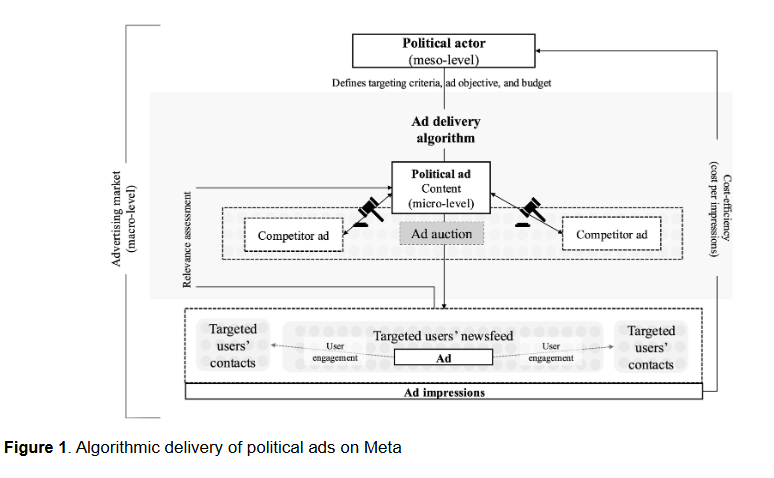
Political parties increasingly seek to extend the reach of their communication within social networks. This often involves harnessing a multi-step communication flow. Simply put, they post content and hope their supporters will engage (like and/or share) that content out into their networks. Parties also invest in promoted advertisement, using platform data to target users with particular characteristics using similar strategies as commercial organisations. Platform policies are fairly opaque in terms of how ads are promoted, confounding researchers understanding the dynamics behind the scenes and understanding what content is seen, by whom, and how it is engaged with yet this is an important issue for understanding the extent party strategies may impact voter choices. Our research explores the relationship between the nature of the content, the spend by the parties and the number of impressions received. Our focus is on negative political advertising, a form of content that research indicates is likely to gain greater levels of engagement across a range of electoral contexts. Our key contributions to knowledge are as follows:
1. the research provides an understanding of how different parties utilise negative campaigning.
2. our unique framework measures performance against cost, so offering a means to understand returns on investment within a political advertising context.
3. as a result we can determine, focusing comparatively across nations and parties, which parties benefit most from negative campaigning.
Key variables
Emotive and affective communication gains engagement on social media, in political contexts it seems content that stimulates negative emotions (anger and fear) are particularly engaging. Hence, we suggest this will hold true for negative campaigning: content which attacks political opponents’ policies, performance, behaviour, or the character traits of leaders or other key figures. Early research suggested negativity was off-putting and could backfire as a strategy, but increasingly research has shown greater engagement for negative campaigning on social media platforms. Thus, parties may be incentivised to seek to push out negative messages to a greater extent, this can be measured by ad spend.
While all parties can pursue a more negative strategy, it is often found to be favoured by opposition parties. Governing parties tend to defend their record and seek a further term in office; the opposition promote a change message by attacking the record and performance of the incumbent government. Parties on the extreme left or right are also more aggressive campaigners, and so found to be more likely to utilise negative campaigning. We test these assumptions by assessing which parties invested most in a negative campaigning strategy while also exploring the demand side, determining how many impressions negative advertisements received in comparison to non-negative ads. But importantly, we also measure the cost-effectiveness of negative campaigning in terms of party position (government or opposition) and ideology.
Our research strategy
Our data comes from an analysis of social media campaigning during the 2019 European parliamentary elections. We conducted a quantitative content analysis of all Facebook ads published by 48 political parties across ten European countries. We focus on the Facebook platform as this was the most utilised by both parties and voters at this contest across all the countries included. We analysed 1,769 unique ads and collected the metadata on spending as well as impressions including repeated exposure. Advertisements were coded for whether or not they included any negative element.
Key findings
While there is no overall pattern in spending on negative advertisements, as predicted, opposition parties invested more in negative campaigning; this was, however, not the case for parties at the ideological extremes. Opposition parties’ advertisements generally received a higher number of impressions, but there was no significant additional boost for their negative advertisements despite their higher levels of investment. By contrast, negative advertisements by ideologically extreme parties achieved greater cost efficiency: despite lower levels of spending, they generated comparatively more impressions. We also found positive effects for advertisements that included videos and for those focusing on immigration.
Overall, however, we find little evidence for the common concern that negative advertisements are systematically advantaged in their reach. At the same time, our findings suggest that the relationship between party characteristics, advertising content, and cost efficiency is more complex than a simple algorithmic preference for negativity or ideologically extreme actors. Parties at the ideological extremes do not appear to be advantaged per se; rather, their greater cost efficiency emerges specifically in combination with negative advertising. Similarly, the effects associated with video content and immigration suggest that the delivery of political advertisements may depend on an interplay between who is advertising, what is being communicated, and how the message is presented. Taken together, these findings highlight the unequal conditions under which platforms shape the reach of political messages, with different types of actors and ads able to achieve visibility at systematically different costs.
Further research
We recognise that European parliamentary elections are unique events. While they offer the opportunity to compare all major parties across up to 28 nations they are second order affairs and may not conform to the norms of domestic electioneering. Further research is needed within the context of national elections. We also recognise that party spend is not reported in full but in intervals. This is a limitation with the metadata that can be extracted from the Meta platform.
However, our insights offer an understanding of party strategies and how spending may not guarantee reach. With advertising becoming restricted on social media there needs to be greater focus on party posts, how they attempt to game algorithms and increase engagement. Social media is a key battleground, and parties are as keen to profit from the attention economy as any commercial organisation. Their strategies for doing this have impacts on how voters view parties, democratic institutions and processes and how they engage and participate. Hence, we need to maintain focus on understanding their strategies.