
Bene Márton & Burai Krisztina (2026). A Perfect Match? The Populism- Social Media Nexus. In. Axel Bruns, Gunn Enli, Anders Olof Larsson, Jessica Yarin Robinson, Tanja Bosch, and Kateryna Kasianenko (eds.). The Routledge Companion to Social Media and Politics, Routledge. (pp. 22-41)
A Perfect Match? The Relationship Between Populism and Social Media
The relationship between populism and social media has become a central concern in political communication research. Digital platforms are often assumed to have played a decisive role in the rise of populist parties and leaders, yet the relationship is more complex than the claim that social media simply “causes” populism. The chapter reviews existing theoretical arguments and empirical findings to clarify how, and under what conditions, social media may support populist politics.
Its main contribution is to organize a dispersed body of theoretical claims and empirical knowledge along two conceptual dimensions.
- First, it distinguishes three interconnected levels at which social media may strengthen populism: (1) by benefiting populist political actors, (2) by encouraging the circulation of populist discourse, and (3) by reinforcing populist attitudes among citizens.
- Second, it argues that these effects can be understood through three characteristics of social media platforms: their architecture, norms, and affordances. This framework also helps explain differences between platforms rather than treating social media as a homogeneous environment.
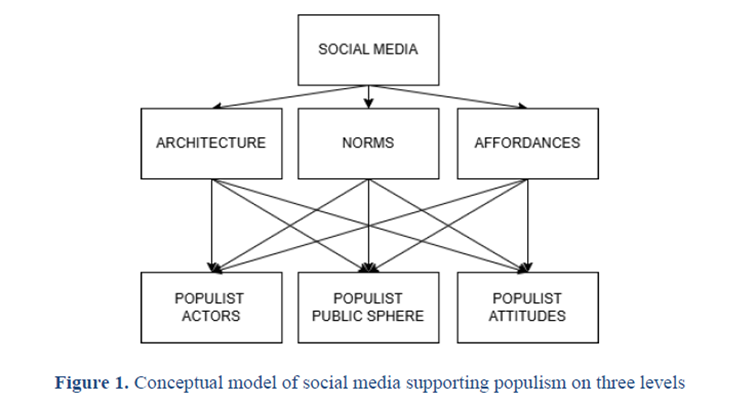
Platform architecture, norms, and affordances
The chapter classifies the main theoretical arguments about social media’s support for populism according to whether they concern platform architecture, norms, or affordances. This distinction is important because platforms differ precisely in these respects.
Platform architecture refers to structural features such as algorithmic filtering, the visibility of followed accounts, and the mechanisms through which users encounter unsolicited content. One central argument concerns disintermediation. Social media enables politicians to communicate without relying on journalists or established news organizations. This direct connection is compatible with the populist claim that politics should rest on an unmediated relationship between the leader and the people. It allows populist actors to avoid journalistic scrutiny, construct alternative interpretations of political events, use simplified messages, and sustain attacks on elites.
A second architectural mechanism concerns content distribution. Populist messages can connect diverse grievances through generalized anti-elitism and an underspecified appeal to “the people.” Their flexibility makes them suitable for viral circulation because users can endorse or share them without adopting a detailed ideological programme. Distribution logics nevertheless differ across platforms. Facebook and Twitter have traditionally relied more heavily on network-based virality, whereas Instagram and TikTok increasingly use interest-based recommendation. Network-based circulation may expose politically uninterested users to populist content through friends and contacts, while interest-based systems tend to reach users already interested in similar material.
Norms refer to the established cultures and practices of particular platforms. Social media is often associated with an anti-elitist ethos that gives visibility to ordinary citizens and amateur content. This “voice of the people” orientation corresponds closely to populist ideology, but it is not equally strong everywhere. Facebook is particularly compatible with people-centred communication because of its heterogeneous user base and community functions. Twitter has historically been more closely connected to journalists and political elites, while Instagram is shaped by celebrity culture and TikTok by popularity-based video distribution.
Affordances are the possibilities for action that actors can exploit within these environments. Populists can perform authenticity, present themselves as ordinary citizens, solicit feedback, circulate supporters’ content, and create participatory spaces. They can also use platforms to attract traditional media attention. Social media is therefore not only a means of bypassing journalists but also a mechanism for entering mainstream news coverage. It also provides aggregative affordances: dispersed and dissatisfied individuals can be brought together around a leader or a symbolic conception of “the people,” thereby converting individual grievances into a shared political identity.
What does the empirical evidence show?
Most existing knowledge concerns the strengthening of populist political actors. The most robust finding is that populist actors frequently perform well on social media. Comparative research generally identifies higher levels of user engagement around populist actors on Facebook and Instagram. Evidence from Twitter is less consistent, indicating that the advantages associated with populist communication depend on platform-specific structures and norms. Populist messages also tend to generate more engagement than non-populist messages, particularly on Facebook.
Populist actors are especially effective at eliciting emotional responses. Their communication is often more negative and confrontational, and it frequently provokes anger. Since negative emotions may contribute to political mobilization, emotional intensity may partly explain the online success of populist communication.
However, there is no conclusive evidence that social media engagement directly produces electoral success. Populist politicians may receive more comments, shares, and reactions, but existing research does not show that these indicators necessarily translate into votes. The evidence therefore supports the claim that populism often succeeds within digital communication environments more strongly than the broader claim that social media causes populist electoral victories.
The literature also shows that populist communication is usually fragmented. In a cross-national study of the 2019 European Parliament election campaign, 23 per cent of party posts on Facebook contained at least one populist element. Yet only 0.7 per cent contained all three major components, while people-centrism and anti-elitism appeared together in only 3 per cent. A single post may therefore not constitute a complete populist message. Instead, separate elements accumulate across a sequence of posts and gradually form a coherent narrative.
A further distinction concerns populist ideology and populist style. Emotionality, negativity, simplification, personalization, and leader-centred communication often accompany populist claims, but these features are not exclusive to populists. Some studies suggest that the high engagement generated by populist communication may be driven less by its ideological content than by these stylistic characteristics. The distinction is particularly difficult in visual communication, where populist and non-populist actors often employ similar strategies.
Populist discourse and effects on citizens
Knowledge about the other two dimensions is much more limited. Social media may strengthen populism by shaping the wider communication environment, not only by benefiting populist politicians. News organizations increasingly adapt their content to platform logics that reward sensationalism, emotional intensity, and conflict, potentially encouraging the circulation of populist styles and narratives. Citizens also contribute by expressing grievances, identifying elites or outgroups as responsible, and connecting with like-minded users. Nevertheless, there is no robust empirical account of whether citizens actively generate populist discourse on social media or how this process differs across platforms.
The effects of social media use on citizens are similarly uncertain. Some studies associate political social media use with stronger populist attitudes and greater support for populist parties, but the causal direction remains unclear. Social media may reinforce populist attitudes, but citizens who already distrust elites and traditional media may also be more likely to rely on social platforms.
Limitations and conclusion
The literature remains heavily focused on parties and national leaders, particularly in Western Europe and the United States. Much less is known about citizens, local politicians, movements, influencers, media organizations, and automated actors. Research has also concentrated disproportionately on Facebook, Twitter, and Donald Trump, while Instagram and TikTok remain comparatively underexamined.
The chapter’s conclusion is therefore conditional. Populism and social media are compatible because platform structures facilitate direct communication, emotional mobilization, leader-centred communities, anti-elite narratives, and the aggregation of diverse grievances. Nevertheless, this compatibility varies across platforms and does not by itself demonstrate offline political effects. The most important claims in the field—especially that social media strengthens populism electorally or transforms citizens’ attitudes—remain the least conclusively tested. Future research must therefore examine a wider range of platforms, actors, regions, causal mechanisms, and consequences outside the digital sphere.