
Bene, M., Illés, G., Russmann, U., Baranowski, P., Haßler, J., Kruschinski, S., Bos, L., Jensen, J. L., Larsson, A. O., Macková, A. & Segesten, A. D. (2026). Constructing representation: Political actors’ representative style on Facebook during European and national election campaigns. European Journal of Political Research, online first, 1-24.
How Political Leaders Construct Representation on Social Media
Political representation is usually discussed in terms of institutions, elections, policy preferences, and responsiveness. Yet representation is also constructed through communication. Political leaders do not simply tell voters what they would do in office; through the way they communicate, they also convey what kind of representative they intend to be, whom they seek to represent, and what they believe the relationship between representatives and citizens should look like.
This is the starting point of our study of political leaders’ Facebook communication during European and national election campaigns. Drawing on constructivist approaches to political representation, we argue that communication does not merely describe an already existing representative relationship. It actively contributes to defining its content. A politician who constantly discusses public policy offers a different model of representation from one who emphasizes personal qualities, presents themselves surrounded by ordinary citizens, speaks in the name of “the people” or specific social groups, or primarily attacks political opponents.
We capture these differences through the concept of representational style. Style here does not simply refer to tone, language, or presentation. It combines form and content: it is the recurring pattern through which politicians communicate what representation means in their case. Rather than defining styles in advance, we examine how different elements of representation are combined in politicians’ actual communication.
Six elements of representational style
We distinguish six communicative elements. Their relative prevalence in a politician’s communication defines the broader representational offer they make to voters.
The first is policy representation: emphasizing public policy issues, positions, and substantive political problems. Here, representation is primarily presented as advocating particular policies.
The second is personal representation, in which politicians foreground their own characteristics, competence, personality, preferences, or private life. The representative offer rests more directly on the individual political actor.
Third, contact-based representation emphasizes the connection between politicians and citizens. Politicians may present themselves among ordinary voters or encourage direct contact, thereby communicating accessibility and attentiveness.
Two further dimensions concern the constituency that politicians claim to represent. Group representation addresses specific social groups—such as occupational, religious, gender, age, or family-status groups—and therefore presents society in pluralistic terms. People-centric representation, by contrast, invokes “the people” as a unified whole and constructs representation around an apparently homogeneous political community.
Finally, antagonistic representation defines representation partly through opposition: politicians emphasize whom or what they stand against by criticizing other parties and political actors. Representation is constructed not only through promises about what the representative will do, but also through rejecting undesirable political alternatives.
Studying political leaders across Europe
To examine how these elements come together, we analyzed the Facebook communication of 110 political leaders in eight European countries—Austria, the Czech Republic, Denmark, Germany, Hungary, the Netherlands, Poland, and Sweden—during both national elections and the 2024 European Parliament election within the framework of the CamforS and DigiWorld international collaboration. The dataset contains 7,854 Facebook posts, coded through a multimodal manual content analysis covering both textual and visual communication.
The analysis first examined differences in the six individual elements and then identified recurring combinations of them at the politician level.
Representation is still strongly about policy—but not only about policy
Policy was by far the most prominent element in political leaders’ Facebook communication. On average, it appeared much more frequently than any other dimension, although politicians also differed substantially in how strongly they emphasized it. Antagonism was the second most common element, followed by references to specific social groups.
Figure 1. Presence of the elements of the representation style in political leaders’ Facebook communication
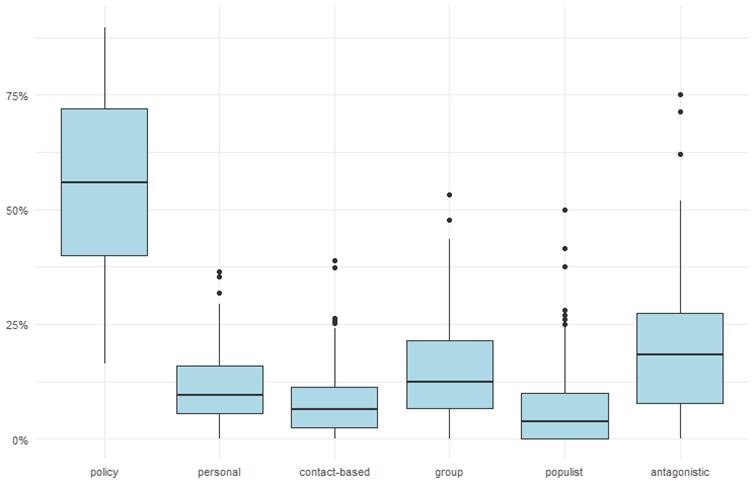
Some important contextual patterns also emerged. National election campaigns were more antagonistic than EP campaigns and contained more references both to specific groups and to “the people”. Politicians therefore appeared more willing in national campaigns to specify explicitly whom they represented and, equally importantly, whom they opposed.
Ideology also mattered. Radical-right politicians used substantially more people-centric and antagonistic communication than mainstream left-wing and right-liberal politicians. They also placed relatively strong emphasis on policy, while being less likely to foreground their personal qualities or direct contact with voters. In contrast, differences between mainstream left and mainstream right were generally small.
National context was even more important. Danish politicians were particularly policy-oriented and relatively reluctant to use antagonism or people-centric rhetoric. Polish leaders emphasized social groups and contact with voters, while Hungarian politicians stood out for their relatively weak policy focus. These country-specific patterns already suggested that representation takes somewhat different forms across Europe.
The clearest picture, however, emerges when the six dimensions are examined together.
Three ways of constructing political representation
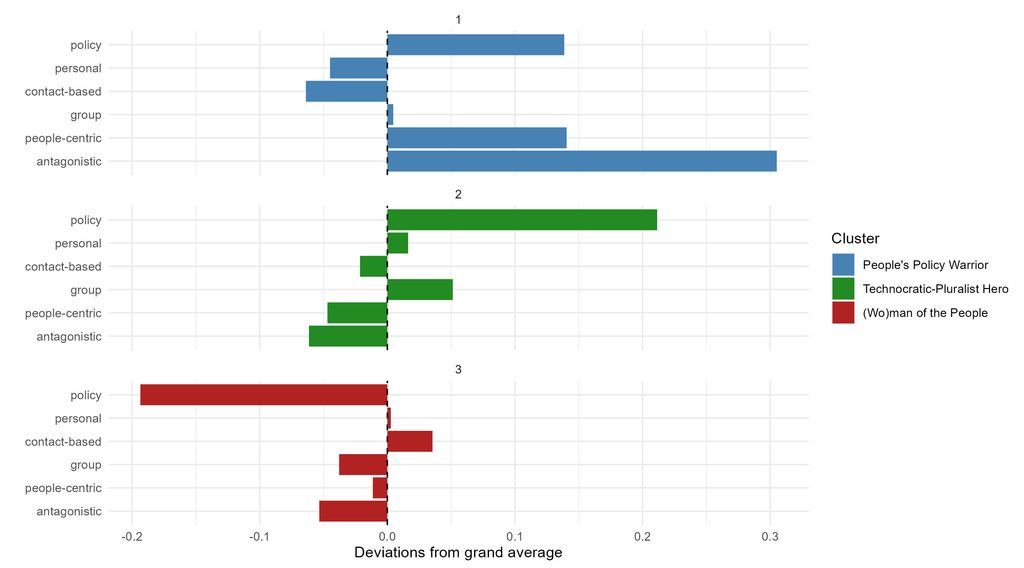
The analysis identifies three recurring representational styles: People’s Policy Warriors, Technocratic-Pluralist Heroes, and (Wo)man of the People. These are not categories imposed theoretically on the data but patterns that emerged inductively from politicians’ actual communication.
Figure 3. The content of the three clusters along the six input variables
People’s Policy Warriors
The People’s Policy Warrior combines a strong policy orientation with antagonism and appeals to a homogeneous people. These politicians talk extensively about substantive political issues, but policy is embedded in a more conflictual narrative in which the interests of “the people” are contrasted with political adversaries. References to specific social groups can also play a role, while personalization and direct voter contact are comparatively less central.
This is the smallest of the three styles. Examples include Herbert Kickl, Geert Wilders, and Swedish Prime Minister Ulf Kristersson.
The style is especially important because it complicates some conventional assumptions about populist politics. Strong people-centric rhetoric does not necessarily replace substantive policy communication: the two can coexist. Nor is this style particularly personalized. In our data, radical-right politicians were considerably more likely than mainstream politicians to adopt this model of representation.
Geographically, People’s Policy Warriors were particularly common in Sweden and Hungary, where roughly a quarter of leaders belonged to this cluster, while the style was absent in Denmark.
Technocratic-Pluralist Heroes
The Technocratic-Pluralist Hero is also strongly policy-oriented, but constructs representation very differently. These politicians largely avoid antagonistic and people-centric rhetoric. Instead, they combine policy communication with appeals to specific social groups and a relatively strong emphasis on their own political persona.
This style therefore links three elements: programmatic politics, societal pluralism, and personal competence. Politicians present society as consisting of different groups whose interests can be represented through policy, while also emphasizing the qualities of the political leader capable of delivering these policies.
Among the politicians classified in this group were Olaf Scholz, Armin Laschet, Danish Green Left leader Kira Peter-Hansen, and former Dutch Prime Minister Mark Rutte. This style was especially widespread in Denmark, Germany, and the Netherlands.
(Wo)man of the People
The largest cluster is the (Wo)man of the People. Unlike the first two styles, it is characterized precisely by its relatively weak policy orientation. These politicians also avoid particularly antagonistic communication. Instead, their representative offer is built around direct contact with voters and, to some extent, personal presentation.
The central message is therefore not primarily “I represent these policies” but rather “I am close to you, I listen to you, and I understand you.” Representation is constructed through accessibility and connection.
Examples include Donald Tusk, Viktor Orbán, Petr Fiala, and Manfred Weber.
This style was particularly dominant in Central and Eastern Europe, especially Poland, Hungary, and the Czech Republic. It was also common in Austria. Rather than mandate-based representation centred on policy programmes, it resembles a form of linkage or responsiveness-based representation, in which the politician’s attentiveness and connection to citizens become central to the representative offer.
Different meanings of representation across Europe
Perhaps the most striking result is therefore geographical. Despite decades of convergence in campaigning practices and the shared technological environment of social media, political leaders across Europe do not construct representation in the same way.
A broad East–West divide emerges. In Western European contexts, the Technocratic-Pluralist Hero is much more prominent: representation is frequently built around policy, differentiated social interests, and political competence. In Central and Eastern Europe, the (Wo)man of the People is much more common: representation is more strongly grounded in proximity, accessibility, and responsiveness to citizens.
These patterns may have consequences beyond campaign communication. The Technocratic-Pluralist style appears compatible with a mandate-based understanding of representation, in which voters authorize politicians to pursue policy programmes and can subsequently hold them accountable for their performance. The (Wo)man of the People style implies a different relationship, built more strongly around general responsiveness and the promise of attentiveness. People’s Policy Warriors offer yet another alternative, constructing representation through a combination of substantive positions, appeals to a unified people, and opposition to political adversaries.
The broader implication is that political representation should not be understood as a single, uniform relationship. Politicians actively construct different meanings of representation through communication, and these meanings are deeply embedded in political and national contexts. Social media does not simply provide a new channel through which existing models of representation are communicated. It is one of the arenas in which the content of political representation itself is continuously constructed.