
Rethinking Peace Through Everyday Life
Peacebuilding in protracted conflicts is usually discussed in terms of negotiation tables, armed actors, and formal ceasefires. Yet peace is also constructed in the ordinary texture of daily life. People do not simply wait for peace agreements to arrive. Through the small decisions they make, where to walk, whom to sit with, what to say and what to leave unsaid, they also shape what coexistence actually looks like on the ground.
This is the starting point of my study of youth in Thailand’s Deep South, a region that has experienced more than two decades of armed conflict between Malay resistance groups and the Thai state. Drawing on the concept of everyday peace, I argue that peace is not only something negotiated by elites and formalized in agreements. It is also something continuously built, or strained, by ordinary people managing risk, difference, and uncertainty in their daily routines. A young person who avoids travelling after dark, shares a table with friends of another religion, or speaks up on social media is not merely coping with conflict. They are actively constructing a version of what peace means in their own lives.
Inside the Interviews Across Three Conflict-Affected Provinces
To understand how this happens, I conducted in-depth interviews with sixteen youth aged 18 to 23 from Pattani, Yala, and Narathiwat, the three provinces at the heart of the conflict. Participants came from Malay-Muslim, Thai-Buddhist, and Sino-Thai backgrounds, reflecting the region’s religious and ethnic diversity. Rather than treating them as passive victims or as formal peacebuilding actors, the study asked how they themselves interpret conflict, negotiate difference, and imagine their futures, foregrounding lived experience over institutional accounts.
Three Interconnected Ways Youth Practice Peace
The analysis identified three connected domains through which everyday peace takes shape: managing risk under anticipated violence, negotiating difference in daily multicultural interaction, and orienting toward future possibilities.
Youth accounts of conflict were marked by direct exposure to bombings and shootings, the militarisation of everyday spaces like schools, and the mental toll of living with constant anticipation of danger. Some participants recalled specific incidents from childhood that had settled into memory, a bomb heard from a distance, a military presence near a classroom, moments that reshaped how they moved through daily life afterward. Rather than retreating, participants described adaptive strategies, adjusting their schedules, avoiding travel after dark, and normalising precaution, that allowed ordinary life to continue. Several also connected the conflict to a wider economic toll on their communities, describing discouraged investment and stalled local development as part of what conflict had cost them, beyond the violence itself.
In their daily interactions, coexistence was sustained through small, continuous acts of accommodation: sharing a table across dietary restrictions, working around language differences, explaining religious practices to curious peers. These moments were not framed as deliberate peacebuilding efforts, but as unremarkable parts of school and community life, which is precisely what makes them significant. Schools in particular emerged as a key site for this negotiation. Participants who attended religiously mixed schools generally described a more fluid, comfortable sense of diversity than those from single-community environments, suggesting that the setting in which young people first encounter difference shapes how they carry that openness forward.
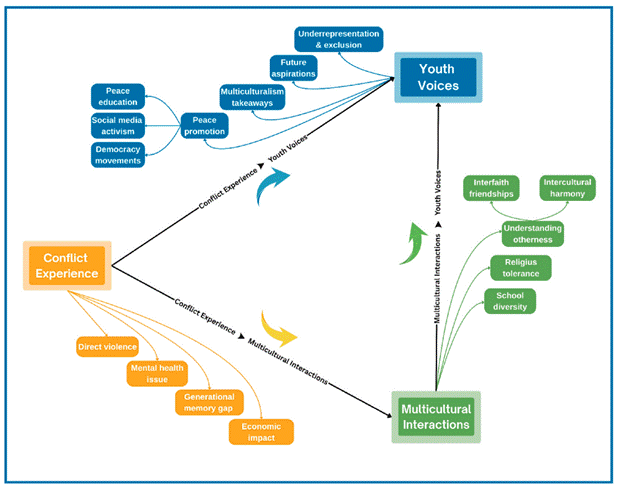
Fig. 2. Relational pathways linking youth conflict experiences, multicultural interactions, and everyday peace narratives in the Deep South of Thailand.
Where Peace Meets the Future: Education and Social Media
The most forward-looking dimension of the findings concerns how youth connect peace to education and social media.
Education emerged repeatedly not as a technical fix for ending violence, but as a moral and civic project: a means of understanding the roots of conflict, learning to negotiate across difference, and imagining alternative futures. At the same time, participants were candid about the structural failures undermining that promise. A shortage of qualified teachers willing to work in the region, under-resourced schools, and educational outcomes that lag behind the rest of Thailand all limit what education can deliver. Peace, in their narrative, is inseparable from equitable access to quality education, an aspiration youth hold onto precisely because it remains out of reach for many of their peers.
Social media, meanwhile, was consistently named as a tool for reclaiming narrative control. Youth described using platforms like TikTok and Facebook to counter the stigma attached to the Deep South as a place defined only by danger, and to share information about the region on their own terms. As two participants put it:
“We should speak up on social media about what’s truly going on in the Deep South, because many people are misunderstood and have a stigma that our areas are all about dangers.” (Y15, Malay-Muslim, Pattani)
“I want to be an activist by using social media to promote peace, to share information faster.” (Y12, Thai-Buddhist, Yala)
This finding pushes back against the assumption that youth in conflict zones mainly encounter social media as a source of fear or misinformation. Rather than being merely a space of exposure to conflict-related fear, which it also was for some, social media functioned for many participants as an instrument of voice and self-representation, a way of participating in the peace narrative even while remaining excluded from formal negotiations, such as the 2023 Berlin Initiative talks, from which youth representatives were absent.
Social media’s role went beyond activism. For some participants, it was also where they first learned about the conflict itself, in contrast to peers whose understanding came from family accounts passed down at home. That distinction matters: as older generations grow more reluctant to discuss the conflict’s origins, platforms like TikTok and Facebook are increasingly filling the gap, shaping not just how youth express peace, but how they come to understand the conflict in the first place. This activist use of social media also echoes a broader pattern among Thai youth, several participants linked their own online engagement to the wider Thailand’s 2020 pro-democracy movement, suggesting that peace promotion in the Deep South is not isolated from youth civic activism nationally.
Peace Beyond the Negotiation Table
Taken together, these findings suggest that peace in a protracted conflict, unfolding as it does within a multicultural society, cannot be understood only through the lens of formal processes and elite actors. Schools, peer networks, and digital platforms are themselves sites where the meaning of coexistence is practiced, contested, and renewed. For youth in the Deep South, peace is less a signed agreement than a set of everyday commitments: to education, to mutual accommodation, to being heard.
The findings also carry practical implications for peacebuilding policy in the region. If education is where youth locate their hopes for a more peaceful future, then persistent gaps in teacher quality and school resources are not simply an education problem; they are a peacebuilding gap. Likewise, if social media has become a primary channel through which young people both learn about the conflict and advocate for change, then peace initiatives that overlook digital platforms are missing a space where the next generation is already doing this work. Recognising youth as interpreters of conflict and coexistence, rather than only as its subjects, points toward a more inclusive model of peacebuilding, one that treats classrooms and social feeds as seriously as negotiation tables.
The implication extends beyond this region. Where conflict is protracted and youth are structurally excluded from peace processes, understanding how young people themselves interpret and enact peace is not a secondary concern. It is central to building settlements that youth will actually inherit and sustain.